Reddit Ads Guide
Reddit Ads vs Organic Reddit Marketing: Which Wins in 2026?
Full disclosure before anything else: I run Reddit ad campaigns and I run a service for the organic side, so I'm not a neutral referee in the Reddit ads vs organic debate. What I can offer is the comparison I wish someone had shown me before I spent money on both. Ads buy you speed and control. Organic earns you search visibility that keeps paying after you've stopped working. Neither replaces the other, and anyone who claims otherwise is selling something. If you're new to the paid side entirely, my complete Reddit ads guide covers formats, targeting, and setup; this page is about deciding where the money goes.
What $1,000/month buys you in Reddit ads
Start with the arithmetic. Median Reddit CPC in 2026 runs $1.25–$1.85 (Stackmatix benchmarks, Jul 2026), which puts $1,000 at roughly 540–800 clicks. Agency-aggregated benchmarks (Recho and Stackmatix both publish these; neither publishes methodology, so treat them as directional) show 2–8% conversion for signups and installs, 1–3% for purchases. Run it through: 11–64 signups a month, or 5–24 sales. Cost per signup lands somewhere between $16 and $90.
For a B2B audience, that's cheap. LinkedIn CPCs for the same buyers run $3–$15 on Stackmatix's cross-platform tables, and one anonymized Stackmatix case study describes a dev-tools company pulling $18K a month out of LinkedIn and into Reddit, landing cost per MQL at $72 instead of $185 on a $1.85 CPC. Reddit's own success stories include Chargeblast cutting CAC by 75%.
And money aside, ads give you things organic never will:
- An answer this month. Launch on Tuesday, read data on Friday. Within two weeks you'll know whether your message lands with r/devops or dies there.
- Targeting you choose. You pick the subreddits, interests, and geos. Organic makes you go wherever the conversation already lives.
- Numbers you can defend in a budget meeting. Pixel, conversions, CPA by campaign. Organic attribution is loose by comparison, and I'll get to that below.
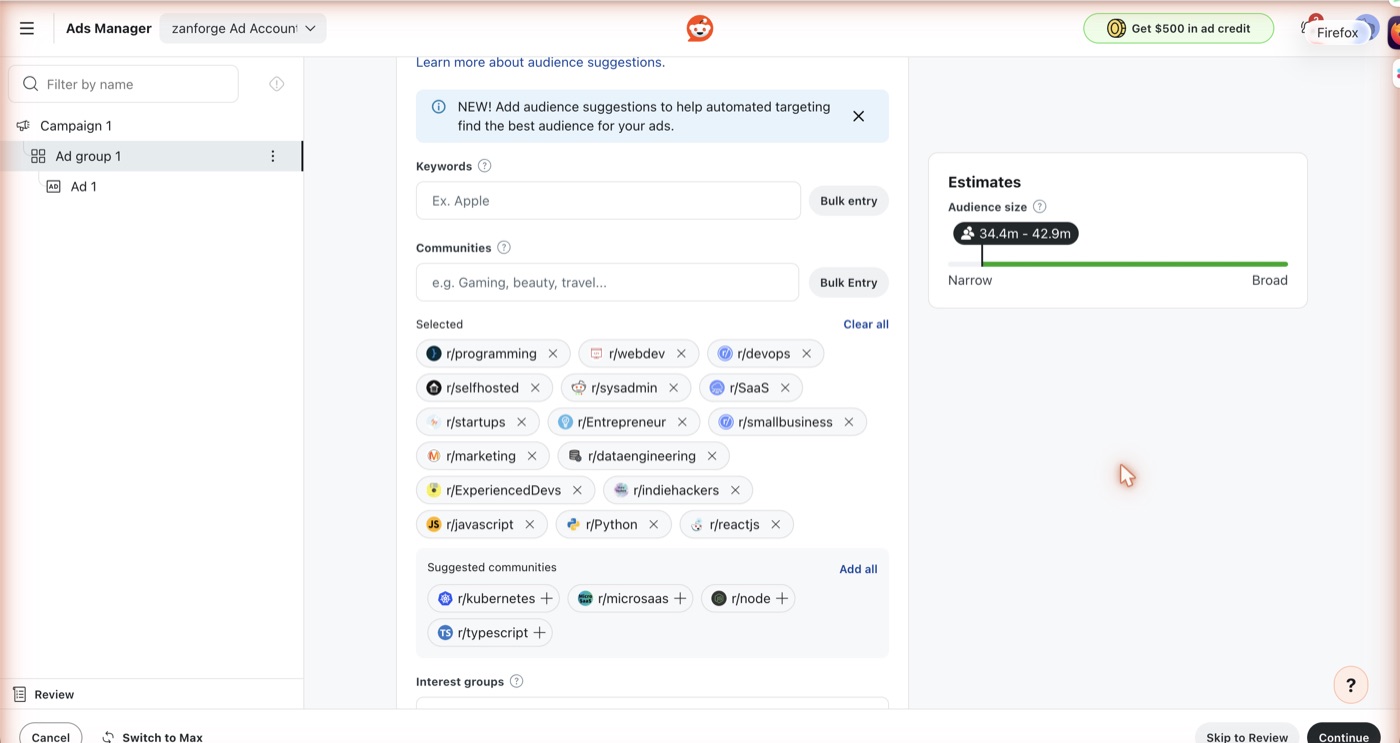
Two things decide whether your $1,000 lands at the good end of those ranges or the bad end. Subreddit selection is the first: long-tail communities of 50K–200K members price 30–50% below median CPM per Stackmatix, and they're usually where the buying conversations happen anyway. Creative is the second, and it has to look like Reddit. The cautionary tale here is a Moss Technologies test reported by Zapier: $100 spread thin over two weeks at bottom-dollar bids produced exactly one conversion. Cheap clicks pointed at the wrong people are still wasted money.
If you're pricing out a campaign, I've broken down what Reddit ads cost across every format separately: CPMs, video rates, takeover pricing, all of it.
What organic Reddit gets you (and what it costs)
An ad stops existing the moment you pause it. A Reddit thread doesn't. Around 60% of reddit.com's traffic arrives from organic Google search, and Reddit appears in roughly 37% of Google's top-10 results (Demandsage). When a thread you started, or answered well, catches one of those rankings, it keeps intercepting the same buyer question month after month. AI assistants lean on those same threads when they answer product questions, which means a strong Reddit answer now surfaces in places where no ad placement exists at any price.
Here's the mechanism working in the wild. In 2025 an indie developer posted a plain write-up of his ad experiment to r/gamedev: "My experience with 2 weeks of Reddit ads, $250 spent". No landing page, no domain of his own, just a candid post riding reddit.com's authority into the search results. Our team pulled the numbers in Ahrefs (July 2026): the thread ranks top-3 for "reddit ads" and draws about 1,100 organic visits a month from Google. Buying those visits at the median CPC above would cost $1,375–$2,035. Per month. He wrote it once.
None of that is luck. Google has spent the last few years favoring forum content for any query where searchers want a human opinion instead of a vendor pitch, and buyers reinforce it by adding "reddit" to their searches on purpose. A thread that answers a commercial question well inherits reddit.com's domain strength, collects upvotes and follow-up comments that keep it fresh, and sits in a results slot no competitor can outbid you for. Your blog post competes with every agency's blog post. Your Reddit answer competes with other Reddit answers, and most of those weren't written by someone who knows the product category.
That's the upside. The costs are real too, and this is where most "organic is free" advice falls apart:
- It's slow. Weeks of genuine participation before your posts carry any weight, months before anything ranks.
- It's unpredictable. You can't order a front-page thread the way you order 500 clicks. Ten good posts might produce one that matters, and you won't know which in advance.
- It punishes laziness severely. Redditors trust the platform for product research precisely because moderators delete promotional junk. 90% of users trust Reddit when they're researching products (Brandwatch, via Reddit for Business), and mods defend that trust by banning accounts that drop bare links.
- It scales with hours, not dollars. You can double an ad budget overnight. You can't double your available evenings.
Speed vs durability: the real trade-off
Put the two side by side and the pattern holds across every row: ads win everything measured in days, organic wins everything measured in quarters.
| Dimension | Reddit ads | Organic Reddit |
|---|---|---|
| Time to first result | 24–72 hours | 4 weeks to 6 months |
| Cost curve | Linear: double the results costs double the spend | Heavy effort up front, near-zero marginal cost once threads rank |
| Targeting control | Precise: subreddit, interest, geo, device | None; you join conversations where they happen |
| Trust and credibility | The "Promoted" label works against you | High: 73% of users trust fellow-Redditor recommendations (Reddit for Business) |
| What happens when you stop | Traffic ends the day the budget does | Ranked threads keep pulling search traffic for years |
| Scaling ceiling | Budget-bound; premium subreddit CPCs are up 15–20% YoY (Stackmatix) | Effort-bound; capped by the hours you can invest |
| Measurability | Strong: pixel, CPA, ROAS by campaign | Weak: UTM links, brand-search lift, mention tracking |
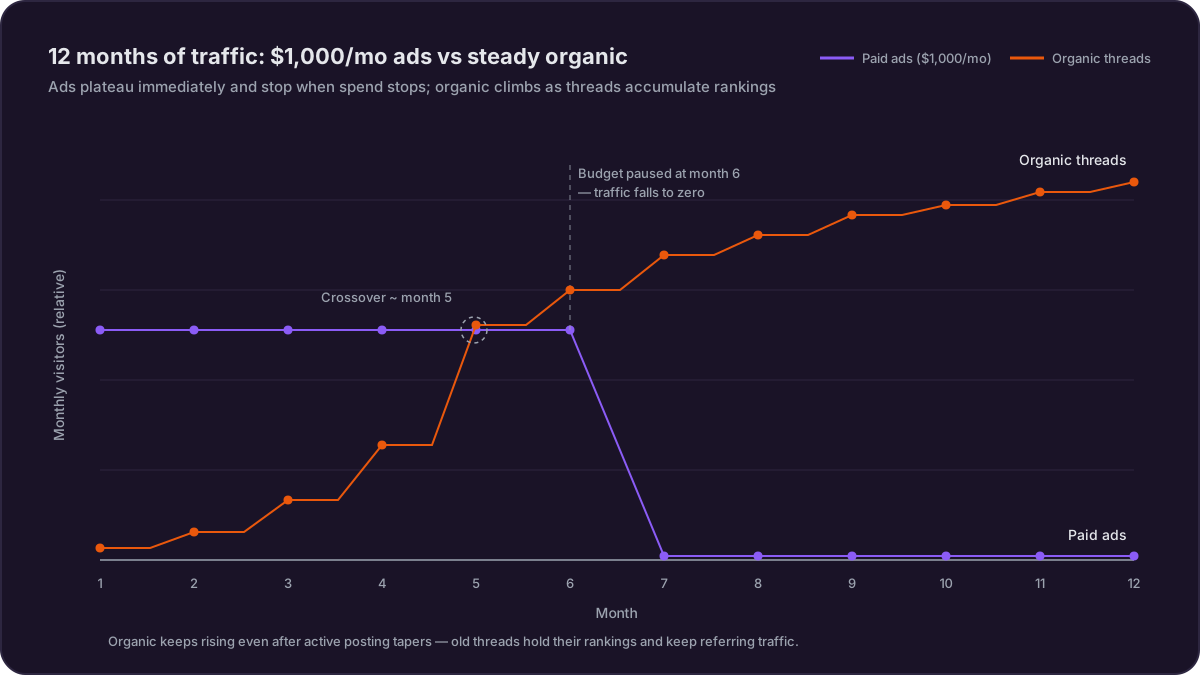
The trap I watch founders fall into isn't picking the wrong column. It's judging organic on ad timelines, killing it at week six because "nothing happened," or judging ads on organic economics and expecting CAC to improve on its own. Each channel has to be graded on its own clock.
When to choose ads, organic, or both
The decision rules I give people:
Validating a new message or product → ads. Spend $500–1,500 over two weeks, the realistic test range per Recho's pricing guide. You'll learn more from 600 real clicks than from a month of internal debate.
Long sales cycle plus high LTV → organic-heavy. A buyer researching a $20K/year contract reads Reddit threads for months before talking to anyone. Threads you wrote last year meet that buyer today. Last year's ads don't exist anymore.
Launch week → both. Organic posts for credibility inside your target subs, ads to force reach during the one week attention is worth the most.
Under $500/month → organic only. Below the realistic testing floor, paid data is mostly noise; you'll spend the money and still not know whether the channel works. Put the hours in instead.
Selling to a skeptical technical audience → weight organic harder than the math suggests. Developers, sysadmins, and security folks read the "Promoted" label as a reason to scroll past. The same people will read a 400-word comment from a founder who clearly understands their stack and click through voluntarily. I've watched identical messaging get ignored as an ad and upvoted as a comment in the same subreddit, same week.
I've written a fuller breakdown of when Reddit ads justify their budget if the spend decision itself is where you're stuck.
How FeedHeat handles the organic side for you
Everything in the organic column above shares one bottleneck: someone has to sit inside Reddit for an hour a day, reading threads, spotting the ones worth answering, and writing replies that don't smell like marketing. That's the job FeedHeat does.
It starts with research: where your buyers talk and what they ask. Then a strategy — a plan you approve. After that it's execution and reporting: regular reports and a monthly AI visibility check, so you can see how your brand shows up on Reddit and in ChatGPT, Perplexity and Google AI Overviews.
The organic column, done for you
Everything in the organic column — finding threads, writing native comments, earning standing in the community — is the grind FeedHeat's team does for you, at a flat monthly rate. Book a demo and we'll walk your subreddits with you.
Book a DemoThe hybrid playbook
If you have budget for both channels, the sequence matters more than the split:
- Weeks 1–4: organic groundwork in 3–5 target subreddits. Comment, answer questions, post nothing promotional. You're learning each community's vocabulary and what it expects from a brand.
- Weeks 5–6: small paid test, $500–1,500. Model the creative on whatever earned upvotes organically. The phrasing that worked unpaid is your best ad copy, and native-looking promoted posts consistently beat polished banner-style creative on Reddit.
- Weeks 7–8: double down where the channels agree. A pain point that gets organic upvotes and paid clicks has been validated twice. That's the message to scale.
- Ongoing: retarget engaged users. Retargeting is Reddit's quiet strength; OnlineLabels reached 13× ROAS with it (Reddit success stories).
- Always: keep organic running underneath. Ads become a dial you turn up for launches and back down between them, while your library of threads keeps growing either way.
The common failure mode is running this sequence in reverse: spending on ads first, then trying to bolt on organic once CAC starts creeping up. By that point you're learning community norms with money on the line, and Reddit charges tuition for that.
Frequently asked questions
Is organic Reddit marketing free?
No. It costs zero ad spend but real hours: expect several weeks of genuine participation before your posts carry weight, plus ongoing time monitoring threads and writing replies. Value that time at any reasonable rate and a serious organic effort costs hundreds of dollars a month in labor. The difference is that the output — ranked threads, account credibility — keeps working after the hours are spent, while paused ads produce nothing.
Can you do Reddit marketing without ads?
Yes. About 60% of reddit.com's traffic comes from organic Google search, and Reddit appears in roughly 37% of Google's top-10 results, so helpful posts and comments reach buyers with no ad spend at all. The trade-offs: it's slower (months, not days), you can't target precisely, and lazy self-promotion gets accounts banned. Under $500/month of budget, organic-only is usually the right call.
Do Reddit ads help organic reach?
Not directly. Running ads gives your organic posts no algorithmic boost. The synergies are indirect: ads tell you which messages resonate before you invest organic effort in them, promoted posts that collect comments show you real objections, and you can retarget users who first found you through organic threads. Treat the two channels as sharing intelligence, not reach.
How long does organic Reddit marketing take to work?
Plan on 4–6 weeks of participation before your posts land well, and 3–6 months before threads start ranking in Google and producing steady search traffic. Individual posts occasionally take off in days, but that's not a schedule you can count on. The compensation for the slow start is durability: a thread that ranks can pull traffic for years without further work.