AI SEO · Playbook
How Reddit threads end up in ChatGPT answers
Your buyers stopped Googling. They ask the model, and they act on one answer. Here's how Reddit discussions feed those answers, and how to take part openly as a brand.
Why now
The funnel moved, and most of your competitors haven't noticed
For fifteen years the job was to rank in ten blue links. A buyer would scan a page of results, open four tabs, and make up their own mind. You could win by being option three.
That's not how a 2026 buyer researches. They open ChatGPT, Perplexity, or a Google AI Overview, describe their situation in a sentence, and get back a short list of two or three products with reasons attached. There is no page two. If the model doesn't name you, you were never in the consideration set, and you'll never see it in your analytics — a buyer who doesn't know you exist doesn't show up as a lost deal.
The mechanics behind that answer are worth understanding, because they're what you're actually optimizing against.
1. Training data
What the model absorbed before it ever met you. Forum threads, discussions and reviews are what shape which brands it "knows" and quietly trusts for a given topic. You can't edit this after the fact — you can only add to what the next model learns from.
2. Live retrieval
What it pulls in real time to answer this specific query. It cites pages it can find, parse, and trust right now. This is the layer you can influence this quarter.
AI SEO (also called GEO) is engineering your presence so you show up in both layers. One source punches far above its weight in both at once.
The lever
Reddit is the highest-leverage surface in AI SEO right now
Not because anyone at Reddit planned it that way. Because of how the models were built, and what they reach for when a question sounds like it needs a human opinion.
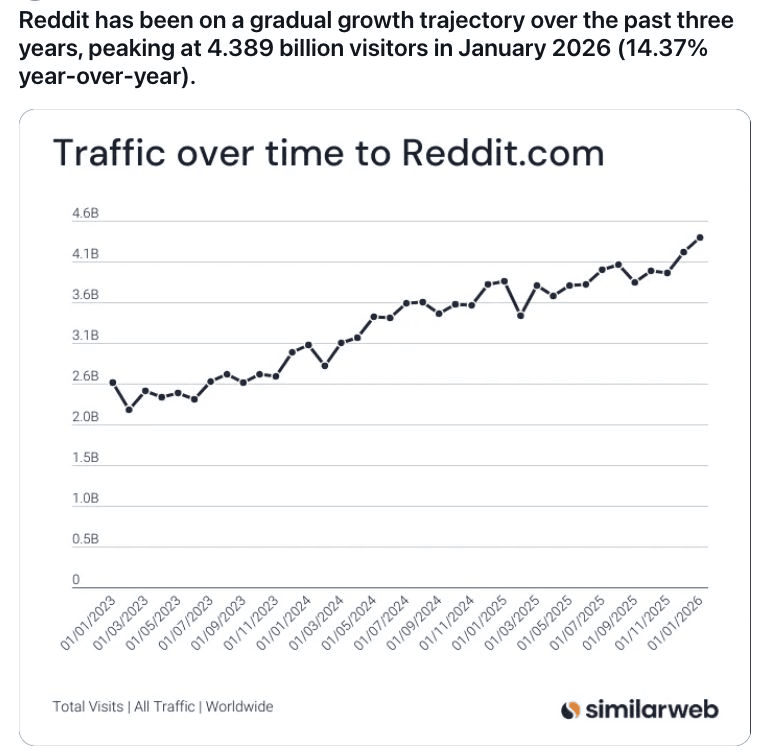
Sources: Ahrefs; Tenet, "How To Use Reddit for AI SEO". In some categories Reddit accounts for over 40% of citations across AI platforms.
Why it compounds
- The major AI labs license Reddit data to train on. A thread can be cited, and it can also end up in training data.
- It wins exactly the queries that matter commercially. "Best X for Y", "A vs B", "alternatives to Z" — for these, a model often reaches for real human discussion over your product page. Your landing page is a claim; a thread is evidence.
- A good thread is evergreen. It can keep getting cited months later. Compare that to an ad, which dies the moment the budget does. This is the closest thing to an appreciating asset in paid-adjacent growth.
- It's also the only channel that hands you your buyers' actual vocabulary — the words they use before your category page teaches them yours.
Set expectations correctly with your team: most Reddit links are nofollow, and upvotes aren't a Google ranking signal. This channel does not move classic keyword rankings directly. What it moves is AI citations, branded search volume, and high-intent referral traffic. Report it that way or you'll get defunded in Q2.
The mechanic
Four traits separate a thread that gets views from one that gets cited
Plenty of threads go viral and are never quoted by a model. The difference is boring and structural.
Intent match
The thread answers the exact question a person would type into ChatGPT — in their phrasing, not your category's.
Entities
It names the real things: product, use case, constraint. The model needs something concrete to map, not adjectives.
Comparison + experience
"We tried A, it broke at B" is quotable. "Best-in-class solution" is not.
Evergreen
Not pinned to a launch or a news cycle, so it stays quotable for months instead of weeks.
Threads with all four are the ones models tend to quote. The rest of this playbook is how to hit all four on purpose.
The playbook
The 10-step flow
This is the operating procedure, in order. Steps 1 and 2 are where most teams skip ahead and lose the channel.
Build a prompt map, not a content calendar
Don't start from post ideas. Start from the real questions your buyer asks a model. Pull them from sales calls, support tickets, your FAQ, objection notes, churn interviews, and competitor comparison pages. Cluster by theme, and for each cluster write down four things: entity, use case, constraint, problem/comparison.
The intent classes that get cited most:
- Q&A— "How do you…", "What's the best way to…"
- Comparison— "A vs B", "best X for Y", "alternatives to X"
- Experience— "People who switched…", "worth it?", "what changed after 3 months?"
- Troubleshooting — "Why does X happen when Y?", "How to fix X without Y?"
- Trade-off— "What do you lose if you choose A over B?"
Check the SERP before you write anything
For each cluster, search site:reddit.com [your keyword] and look at the normal Google results. Is there already a Reddit thread ranking for this intent? Does it match on entity, use case and constraint, or only look similar? This single check decides the next step, and it takes two minutes.
Decide: enter or create
If a relevant thread already ranks — go into it. It already carries the authority you'd spend months building. Write one strong, intent-matched comment with experience, comparison and constraints. Answer the follow-ups. Close with a useful summary. A great comment on a ranking thread beats a new thread nobody finds.
If nothing relevant ranks — create your own, using the title and body formulas below.
Write the title to the formula
The title has to hand the model four things instantly: entity + use case + constraint + comparison/problem. Full templates in the next section.
Write the body in 80–220 words
Who you are and the context → constraint → what's been tried → criteria → one clear question. Every paragraph adds signal or gets cut. Longer is allowed if the topic earns it; padding is not.
Publish, and leave room
Post to a relevant subreddit. Don't overload the body — you want replies, and a body that answers everything gets none. Post from your brand or team account and say who you are in the post. Log the URL, timestamp and the cluster's main intent in a sheet.
Work the comments — an untended thread dies
Answer 2–4 clarifying questions. Expand on your constraints when someone adds context. Ask people to compare options on specific criteria. Then post a summary comment from the same account:
Mention your brand openly, or get removed
Every mention of your product comes with who you are.
Do
- "I'm on the team at X, here's how we handle it…"
- "I'm on the team at X. We tested X and Y — here's where it broke"
- Always say who you are — e.g. "I'm on the team at X".
Don't
- "Here's our product, highly recommend"
- Drop a link in the first comment, unprompted
- Paste identical mentions across subreddits
Link last, and never to the homepage
Discussion first. Add a link only when someone asks for detail or the sub explicitly allows it — and point it at a comparison, FAQ or use-case page that stands on its own. Your homepage answers nobody's question. Tag it (?utm_source=reddit&utm_medium=social&utm_campaign=[subreddit]) so you can prove the channel later.
Check indexing, then monitor
A thread can't be retrieved if it isn't indexed. After publishing and the first round of comments, track whether the thread is indexed, how the discussion grows, and whether citations appear.
The one-line SOP: mine prompts → check if a Reddit thread already ranks → if yes, comment in it; if no, build your own to the template → publish from your brand or team account and say who you are → work the comments → link only when it helps → check indexing → monitor.
Copy-paste
The title and body formulas
These structures work for disclosed posts from your own brand or team account. Swap the brackets for your category and constraints.
Title framework
entity + use case + constraint + comparison/problem — all four, in the title itself.
Worked example: "Best CRM for a 12-person B2B SaaS with a 60-day sales cycle: HubSpot vs Pipedrive vs Close?" — that title alone gives a model the category, the ICP, the constraint and the comparison set.
Body framework · 80–220 words
Five moves: who you are and the context, the constraint, what people have tried, the criteria that matter, one specific question. The constraint is the part people skip and the part that makes the thread citable — "best CRM" is unanswerable, "best CRM for a 12-person team with a 60-day cycle" is a question a model can match to a buyer.
Quality checklist before you hit post
- Discoverable by search — someone could plausibly land here from Google.
- Matches a real prompt intent and names the entity.
- Gives intent + experience + comparison, not just an opinion.
- Stays evergreen — nothing tied to a one-off event or launch.
- The comments strengthen the context rather than dilute it.
Formats
7 native post archetypes
Every one follows the same spine: hook → insight → proof → community question. Tone throughout: like telling a colleague about something you did last week. Specific, first-person, unbothered.
1. Problem–Solution
A first-person story about a real problem you hit. Hook (a frustration people recognize) → the deeper cause, not the symptom → what actually fixed it → a casual question back to the room.
2. News
React to a release, paper or industry update. Hook (the news) → what it actually is → why it matters to this audience → how will you use it. Factual. Hype reads as marketing.
3. Use Case
A walk-through of solving a real workflow. Scenario → steps → tools and setup → outcome with numbers → question. A mini case study told from experience.
4. Discussion
An opinion on a trend, designed to spark debate. Claim → reasoning → examples from your own work → open question. Opinionated, not aggressive — you want argument, not applause.
5. Resource Share
A useful repo, dataset, tool list or reading list. What it is → what's in it → why it's worth the click → link if allowed → "anyone got similar?" Helpful and short.
6. Comparison
Compare tools fairly. Overview of each → the real differences and trade-offs → which fits which use case → which do others prefer. If your own product is in the comparison, say so at the top and be fair to the others.
7. Question / Advice
Ask for help on a real problem and say up front that you work on [product]. The issue, your setup, what you've tried, then the question.
CQS and your brand account
CQS: the hidden score that decides whether anyone sees you
You can execute everything above perfectly and still get filtered before a human reads a word. Reddit rates every account on a Contributor Quality Score — a trust rating built to catch likely spammers.
- What feeds it:your account's past actions, network and location signals, and account security — 2FA, verified email, a real history.
- Five tiers: Lowest · Low · Moderate · High · Highest. Scores update regularly; you can move up or down.
- Moderators use it directly via the
contributor_qualityfield in AutoMod, so low-CQS accounts get auto-filtered in exactly the strict, high-intent subs you want to be in.
How to check yours — Reddit won't show you
Post anything (literally "checking my CQS") in r/WhatIsMyCQS. A bot replies within minutes with your tier. Do this with your brand account before you post from it. If it comes back low, fix the basics first — verify the email and turn on 2FA — before posting anywhere that matters.
Where to start
Start where your team already participates
Post from your brand's or team's own account, say who you are, and read each subreddit's rules before you mention your product.
Communities that welcome founders and builders
High-intent, stricter subs where the buyers are
Plus the niche subs specific to your product — those usually convert better than any of the above, they're just smaller. Target subs with 5,000+ members and daily activity, and read the rules before you engage.
Take part in discussions before you post about your product, and say who you are every time.
Proving it
How to measure a channel with no click
The awkward part of AI SEO: the citation that wins you the deal produces no referrer. Someone reads your name in a ChatGPT answer and types your domain in directly a week later. Here's what we actually watch.
- Branded search volume in Search Console. The cleanest proxy. When the model starts naming you, people start googling you by name.
- LLM-referred sessions. Small but real, and the trend line matters more than the absolute number.
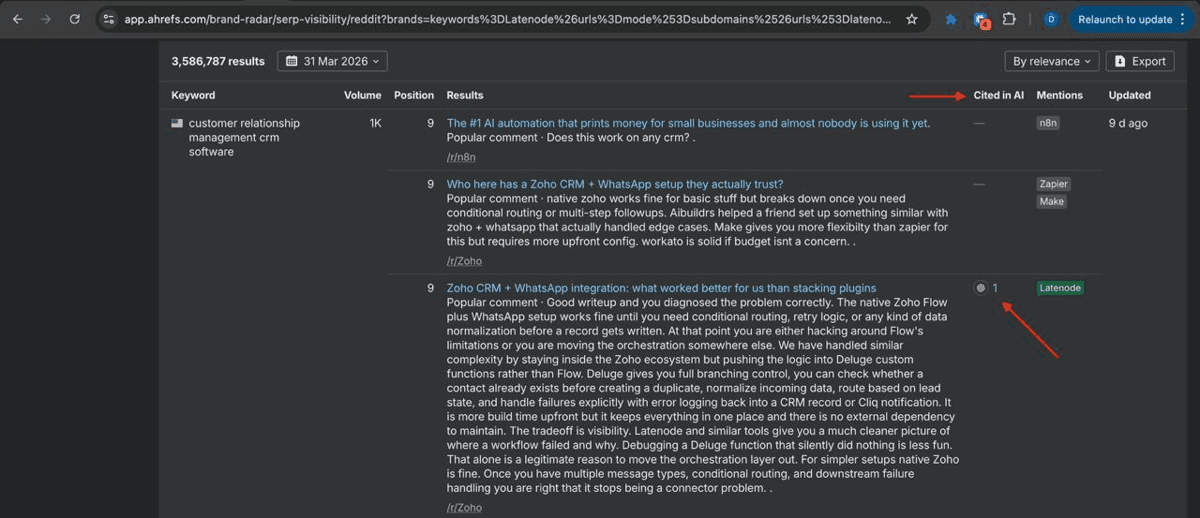
- Manual citation tests, monthly.Take your top 20 prompts from the prompt map, run them across ChatGPT, Perplexity, AI Overviews and Grok, log whether you're named. Tedious, unambiguous. Tools like Ahrefs' Brand Radar automate it once you outgrow the spreadsheet.
- UTM'd referral behavior, not volume. Reddit traffic is low-volume and high-intent. Judge it on time on page, pages per session and conversion — not sessions. A hundred Reddit visitors who read three pages beats ten thousand who bounce.
- A tracking sheet.Subreddit, thread URL, intent cluster, answer type, outcome. Boring, and it's the thing that tells you which cluster to double down on in month three.
Wrapping up
If you remember three things
- AI SEO is the new front door.The goal isn't to rank, it's to be the answer — and Reddit is one of the strongest levers you have on it.
- Write for intent + entity + comparison + evergreen. Discussion first, link later, homepage never.
- Post openly.Say who you are, follow each sub's rules.
None of this needs a tool. It needs a prompt map, an account that clearly says who you are, and the patience to be useful before you ask for anything. That's the whole trick, and it's why most teams won't do it.
Want it done for you?
See FeedHeat run this playbook
A 20-minute walkthrough of how our team runs it: prompt mapping, subreddit selection, rule-reading, native writing, and citation reporting. We'll look at your category and tell you honestly whether Reddit is a channel worth your time.
Book a DemoNo spam, no drip sequence. A real person replies within one business day.